
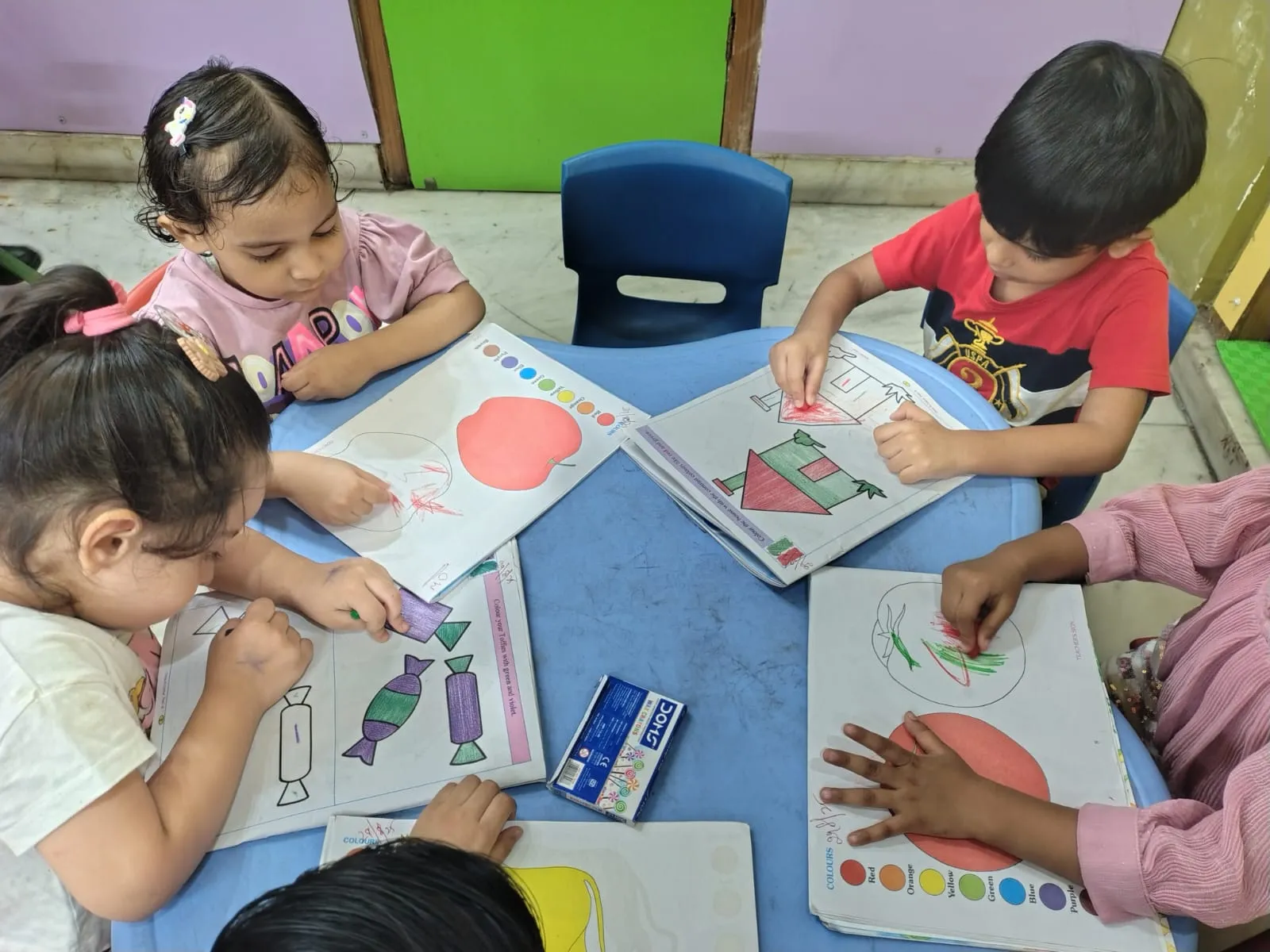
Art time is not a break from learning. When children colour, draw, fold and make patterns, they practise many of the same skills that maths and science depend on.
Here is what is happening when your child picks up a crayon, and a few simple ways to make the most of it at home.
Patterns are early algebra
A bead necklace that goes red, blue, red, blue, or a border of circle, square, square, circle, square, square, asks a child to spot a rule and predict what comes next. That is the heart of algebra: finding the rule behind a pattern and using it.
Symmetry and shape
Folding a sheet of paper, painting on one half and pressing it closed makes a butterfly with two matching wings. Rangoli designs do the same with dots and lines. Children learn words like half, match, line, curve and corner, the vocabulary of geometry, by making things rather than memorising them.
Thinking in space
Drawing a map of your room, copying a block tower from a picture or fitting jigsaw pieces together all train spatial thinking: picturing how shapes move, turn and fit. Researchers have found that children with stronger spatial skills tend to do better in maths, and that these skills improve with practice.
Small muscles, steady hands
Colouring inside the lines, tracing and cutting with child-safe scissors build control of the small muscles in the hand. The same control is needed to write numbers neatly and to draw an accurate graph later on.
Planning and patience
A drawing has steps. What goes first? Which colour comes next? What do I do if I make a mistake? Working through a picture from start to finish builds the same patience a child needs for a long sum or a science project.
Try these at home
- Colour by number: numbers, colours and a hidden picture in one page.
- Dot-grid rangoli: draw a 5 × 5 grid of dots and join them to make a design that is the same on both sides.
- Butterfly prints: paint one half of a folded sheet, press, open and talk about what matches.
- Pattern necklaces: thread pasta or paper beads in a repeating pattern, then ask your child to continue a pattern you start.
Free printable curriculum
Our free bundles for Preschool to Class 5 include hands-on activities like these every month, with a full answer key.